American Guns Are Fueling the Cartels — And We Pretend Not to Notice
Take a wild guess where a large share of the guns recovered from Mexican crime scenes come from. Not China. Not Russia. Not some shadowy offshore arms bazaar. The United States.
CRIMEECONOMICSPOLITICS
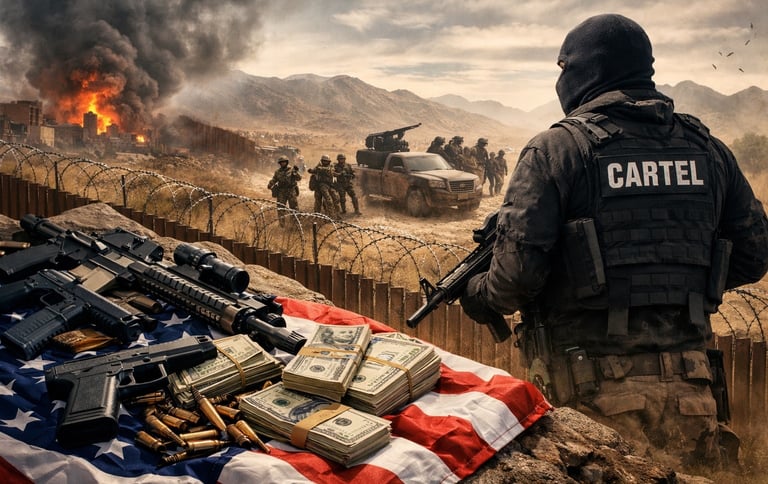
Take a wild guess where a large share of the guns recovered from Mexican crime scenes come from.
Not China. Not Russia. Not some shadowy offshore arms bazaar.
The United States.
According to a 2021 report by the U.S. Government Accountability Office, about 70 percent of firearms recovered in Mexico and submitted for tracing between 2014 and 2018 were traced back to the United States. That figure is routinely rounded up in public debate, but even at 70 percent, the message is clear: American gun markets are a major source of cartel weaponry.
There’s an important caveat — and it actually strengthens the argument rather than weakens it. The 70 percent figure applies only to firearms that Mexican authorities submitted to U.S. authorities for tracing, not to every weapon in cartel possession. But the firearms most likely to be traced are those suspected of having originated in the U.S. That means we cannot say “70–80% of all cartel guns” come from America. What we can say, defensibly, is that U.S.-sourced firearms represent a significant and well-documented pipeline into cartel arsenals.
And that pipeline exists for a reason.
How the Guns Flow South
The Bureau of Alcohol, Tobacco, Firearms and Explosives (ATF) has repeatedly documented the mechanics of southbound gun trafficking:
“Straw purchasers” legally buy firearms in U.S. border states like Texas and Arizona.
Semi-automatic rifles and high-capacity pistols are purchased in bulk.
Weapons are transported across the border in small batches to avoid detection.
The firearms frequently recovered include AR-15–style rifles and 9mm pistols — weapons that are legal and widely available in much of the United States.
This is not a mystery. It’s a market dynamic.
Mexico has far stricter gun laws than the U.S., with only one legal gun store in the entire country, operated by the military. When demand for high-powered weapons collides with limited legal domestic supply, traffickers look north.
The Violence That Follows
Cartels don’t just use these weapons for dramatic firefights. They use them to control territory, intimidate communities, eliminate rivals, and enforce extortion rackets. The result is a sustained level of violence that destabilizes regions and pushes families to flee.
Migration from Mexico and Central America is driven by many factors — economic hardship, climate stress, political instability. But organized crime violence is undeniably part of that equation. When heavily armed criminal groups dominate entire municipalities, leaving is often a survival strategy.
So when Americans express outrage about migration, it’s worth asking: how much of the instability driving it is indirectly tied to U.S. consumer demand and U.S. regulatory gaps?
The Other American Inputs
The gun flow is only one side of the equation.
American drug consumption generates billions in cartel revenue.
American cash and weapons markets provide logistical lifelines.
American political rhetoric often reduces the problem to “Mexican corruption,” as though it operates in a vacuum.
Corruption in Mexico is real. So is cartel brutality. But pretending the United States plays no structural role in sustaining the system is convenient — and inaccurate.
The Accountability Problem
It’s easier to blame another country than to examine our own policies.
It’s easier to talk about walls than to talk about straw purchasers.
It’s easier to denounce “lawlessness” abroad than to confront the fact that firearms bought legally in American gun stores routinely end up in cartel hands.
No serious analyst argues that every cartel weapon comes from the United States. Some originate from Central American military stockpiles. Others circulate through global black markets. But the documented U.S. share is large enough that it cannot be dismissed as incidental.
When a significant portion of traced crime guns in Mexico lead back to American sellers, that’s not a foreign policy issue alone. It’s a domestic policy choice with international consequences.
We can debate gun rights. We can debate border security. We can debate immigration policy.
But we cannot honestly debate cartel violence while pretending the American gun market is not part of the supply chain.
If we want to reduce the violence that drives migration, we have to look at the entire ecosystem — including the one on our side of the border.
AI Generated Image
itsmyview.com © 2023-2025 All Rights Reserved
It's My View empowers people with the knowledge and tools to participate in meaningful political discourse and contribute to positive change.
Reframe your inbox
Subscribe to my blog and never miss a story.
We care about your data in our privacy policy.