Imagine the Outrage—If It Were Anyone Else
Imagine being more upset at a Black man holding a sign that says “Black People Aren’t Apes” than at a President of the United States sharing imagery that depicts the first Black President and First Lady as apes. Because that contrast tells you something—not just about racism, but about power. Where is the outrage?
TRUMPMEDIAPOLITICSREPUBLICANSCULTURE
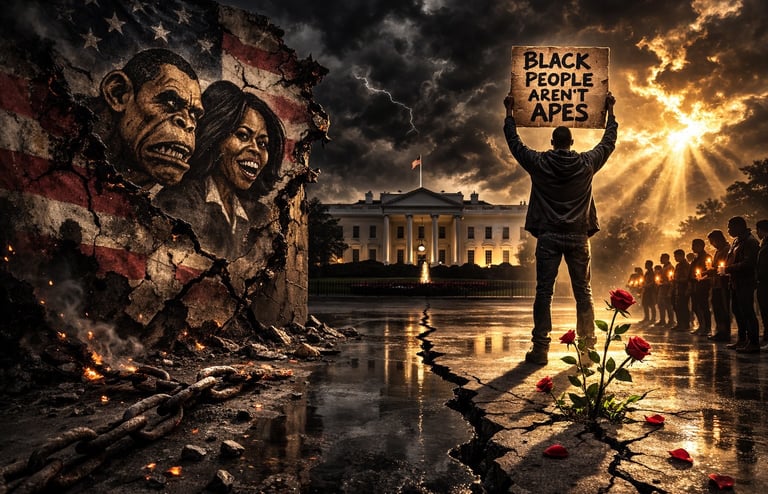
Imagine being more upset at a Black man holding a sign that says “Black People Aren’t Apes” than at a President of the United States sharing imagery that depicts the first Black President and First Lady as apes.
Pause there.
Because that contrast tells you something—not just about racism, but about power. About who gets policed for tone. And who gets protected for cruelty. Where is the outrage?
The Weight of That Image
Comparing Black people to apes is not a random insult. It is one of the oldest and most deliberate racist tropes in modern history.
In the 19th and early 20th centuries, pseudo-scientific racial “theories” were used to portray Black people as biologically inferior—closer to primates than to white Europeans. That dehumanization wasn’t abstract. It justified slavery. It justified segregation. It justified violence.
So when imagery emerges depicting the first Black President, Barack Obama, and the first Black First Lady, Michelle Obama, as apes, it is not edgy humor. It is not satire. It taps directly into one of the most explicitly racist narratives in Western history.
And context matters.
Leadership Has Standards—Or It Should
There are moments that test whether a country still believes in minimum standards of public leadership.
In much of the developed world, overtly racist rhetoric or imagery from a head of government would trigger immediate consequences:
In the United Kingdom, party leadership challenges move quickly.
In France or Germany, governing coalitions fracture under scandal.
Political survival often depends on maintaining legitimacy across a broad spectrum of voters.
Are those systems perfect? No.
But there is still a visible line that, once crossed, carries consequences.
The United States used to have lines like that.
Polarization as Armor
So why doesn’t the same accountability apply here?
Because polarization has become armor.
In today’s media ecosystem, many voters experience politics inside curated realities. What would once have been universally disqualifying is reframed as:
“Just trolling.”
“Taken out of context.”
“The media overreacting.”
“Fighting political correctness.”
When outrage becomes tribal, behavior stops mattering. Loyalty does.
That dynamic protects power—not principle.
The Double Standard
Here’s the uncomfortable part.
A Black man holding a sign that says “Black People Aren’t Apes” is accused of “playing the race card.”
A President sharing dehumanizing imagery is defended as “owning the libs.”
The person objecting to racism becomes the problem.
The person amplifying it becomes the victim of criticism.
That inversion is not accidental. It is how normalization works. First you excuse. Then you minimize. Eventually, you forget it was ever shocking at all.
The Global Comparison
It’s tempting to say authoritarian leaders might survive similar behavior. But even leaders like Vladimir Putin or Xi Jinping rarely engage in openly crude racial caricatures. Not because they are morally restrained—but because they understand power optics. They understand strategic messaging.
The issue isn’t just morality. It’s competence.
When the bar is lowered so far that dehumanizing imagery becomes partisan entertainment, something deeper shifts. The presidency stops being an institution. It becomes a performance stage.
What This Really Signals
This isn’t only about one post, or one incident. It’s about what a country tolerates from its most powerful office.
If standards disappear for the top, they disappear everywhere.
If racism is treated as just another partisan skirmish, its history and harm get erased.
And if defending basic human dignity is seen as more offensive than attacking it, that’s not just polarization. That’s moral inversion.
The Question
The real question isn’t whether critics are too sensitive.
It’s whether Americans still believe the presidency should reflect a minimum level of decency.
Because once you normalize dehumanization at the top, you don’t get to be shocked when it spreads everywhere else.
AI Generated Image
itsmyview.com © 2023-2025 All Rights Reserved
It's My View empowers people with the knowledge and tools to participate in meaningful political discourse and contribute to positive change.
Reframe your inbox
Subscribe to my blog and never miss a story.
We care about your data in our privacy policy.