The Attorney General Should Be the People’s Lawyer — Not a Bodyguard
In a functioning democracy, the Attorney General of the United States is supposed to serve one client: the American public. Not a political party. Not a president. Not a campaign.
DEMOCRACYCOURTSTRUMPPOLITICS
In a functioning democracy, the Attorney General of the United States is supposed to serve one client: the American public. Not a political party. Not a president. Not a campaign. The Attorney General is the nation’s top law enforcement officer, entrusted with defending the rule of law and ensuring justice is applied evenly — without fear, favor, or political calculation.
Yet somehow, in the modern political era, we’ve drifted into a surreal space where the Attorney General is increasingly treated like the president’s personal defense counsel, a glorified political brawler who shields the Oval Office from scrutiny and cleans up the messes that power tends to generate. And the consequences of that shift aren’t abstract — they’re corrosive.
Because when the Justice Department becomes a fortress for the powerful, the public loses its greatest shield.
When the DOJ Serves One Man, the Country Pays the Price
The Department of Justice exists to enforce the law, not manipulate it. Its mandate is simple: protect the public interest, prosecute wrongdoing without regard to status or title, and act as a check — not a cheerleader — for the executive branch.
But we’ve watched, administration after administration, how that principle erodes the moment politics creeps into the equation. When DOJ independence is compromised, the entire justice system becomes distorted. The question stops being “Did someone break the law?” and becomes “Is this politically convenient?”
And that is not justice.
That’s strategy.
The Pam Bondi Parable: Loyalty First, Accountability Last
If you want to understand what happens when law enforcement roles become political loyalty tests, look no further than Pam Bondi — a quintessential example of what goes wrong when loyalty is valued more than independence.
Bondi, the former Florida Attorney General, built her brand not on impartiality but on fealty. She famously accepted a $25,000 political donation from Donald Trump’s foundation while her office was considering joining a fraud investigation into Trump University — a case she ultimately declined to pursue. Ethics watchdogs howled. Transparency advocates cried foul. And ordinary Americans once again saw the same depressing pattern: powerful people getting the benefit of the doubt while the public got excuses.
Later, Bondi resurfaced as one of Trump’s most aggressive public defenders during his impeachment, treating the investigation not as a legal matter, but as a political performance. She became a symbol of the modern problem: people in legal or quasi-legal roles behaving like partisan operatives rather than neutral arbiters.
Her trajectory is a warning — a reminder that when those entrusted with upholding the law see themselves as political combatants, the public loses faith, and the system loses legitimacy.
A Politicized DOJ Isn’t Just Unfair — It’s Dangerous
The danger of a DOJ captured by politics isn’t theoretical. It creates a feedback loop of corruption:
Allies are protected instead of investigated.
Critics are targeted instead of heard.
Wrongdoing becomes excusable if the perpetrator is useful.
Truth becomes optional, depending on who it helps.
This is how democracies slide toward authoritarianism — slowly, then all at once. Not with dramatic coups, but with the quiet normalization of “acceptable” abuses of power.
When the DOJ acts as the president’s shield, the public becomes collateral damage.
Independence Isn’t a Luxury — It’s the Whole Point
The Attorney General must be willing — and empowered — to tell a president “no.”
To tell political allies “no.”
To tell donors “no.”
To tell powerful interests “no.”
Because once the Justice Department answers to political command, justice stops being blind — and starts being obedient.
Pam Bondi’s example is a small-scale version of that problem. When an AG behaves like a campaign surrogate, it signals to the public that law enforcement is just another political instrument. And once people stop believing the DOJ operates independently, the entire justice system loses its moral authority.
We Need a DOJ That Protects the Public, Not the President
What Americans deserve — and what the Constitution intended — is a Justice Department that:
Prosecutes corruption even when it’s politically inconvenient.
Investigates wrongdoing whether the accused is powerful or powerless.
Operates transparently, ethically, and without personal alliances.
Serves the public interest — not the White House’s strategic interests.
The Attorney General should not be a shield, a spokesperson, or a spin doctor.
They should be the people’s lawyer, the guardian of a system that only works if it works for everyone.
And we should demand it — loudly, consistently, and without apology.
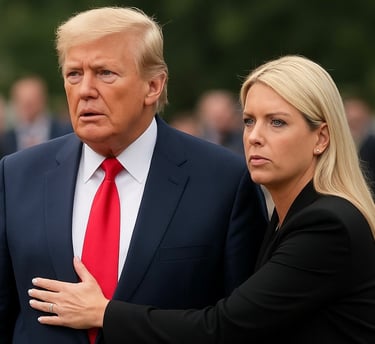
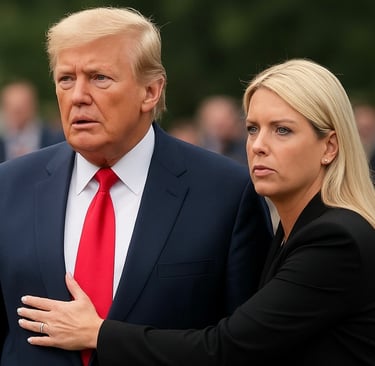
AI Generated Image
itsmyview.com © 2023-2025 All Rights Reserved
It's My View empowers people with the knowledge and tools to participate in meaningful political discourse and contribute to positive change.
Reframe your inbox
Subscribe to my blog and never miss a story.
We care about your data in our privacy policy.