The Exhausting Cycle of American Politics
Every few years, many Americans experience the same sense of political déjà vu as it relates to politics. One party takes power amid economic turmoil, promises sweeping change, and begins stabilizing the situation. Just as progress starts to appear, voters grow frustrated, elect the opposition, and the cycle begins again.
POLITICSDEMOCRATSREPUBLICANSELECTIONS
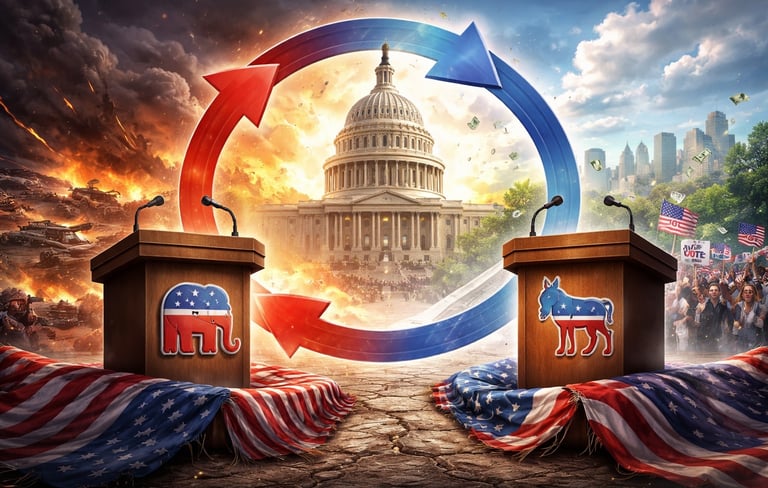
Every few years, many Americans experience the same sense of political déjà vu as it relates to politics. One party takes power amid economic turmoil, promises sweeping change, and begins stabilizing the situation. Just as progress starts to appear, public impatience, media narratives, and new political distractions shift the conversation. Voters grow frustrated, elect the opposition, and the cycle begins again.
For people paying close attention to policy and long-term economic trends, watching this pattern repeat can feel deeply exhausting.
But why does it happen so consistently?
The Lag Between Policy and Results
One of the least appreciated realities of governing is that major economic policies take years to show measurable results.
Changes to tax policy, regulation, infrastructure investment, or social programs ripple through the economy slowly. Businesses adjust, markets react, wages shift, and investment decisions unfold over time. These processes rarely fit neatly inside a two-year congressional election cycle.
The result is a persistent mismatch:
Policy operates on a multi-year timeline.
Politics operates on an immediate timeline.
Voters often judge governments long before the full effects of their policies become visible.
Presidents Inherit the Economy They Walk Into
Another structural feature of American politics is that new presidents inherit economic conditions largely shaped by the previous administration.
Recessions, inflation cycles, employment trends, and fiscal conditions do not reset on inauguration day. Policies enacted years earlier—along with global events, wars, pandemics, and financial crises—continue shaping the economy.
Historically, many administrations have spent their first years responding to crises they did not create, while the policies they implement may influence the economy well after they leave office.
This timing mismatch often creates confusion about who deserves credit—or blame—for economic conditions.
War and Political Power: A Pattern Over the Last Half-Century
Another aspect of this political cycle that is frequently debated is America’s involvement in military conflicts.
Over the past fifty years, many of the most significant U.S. military engagements began under Republican administrations. Examples often cited include:
The escalation of Cold War military interventions under Ronald Reagan
The Gulf War initiated by George H. W. Bush in 1991
The War in Afghanistan and the Iraq War launched by George W. Bush after the September 11 attacks
Supporters of these decisions argue that the conflicts were responses to geopolitical threats or acts of terrorism. Critics argue they reflect a pattern of interventionist foreign policy that carries long-term economic and human costs.
What is clear is that wars—once begun—rarely align neatly with political terms. The wars launched under one administration are often managed, expanded, or ended by the next, regardless of party.
For example, the Afghanistan War continued through the presidencies of Barack Obama, Donald Trump, and Joe Bidenbefore its final withdrawal in 2021.
Like economic policy, military conflicts often outlast the political cycles that created them.
Culture Wars Crowd Out Economic Policy
Complex economic debates rarely dominate the political conversation for long.
Cultural and identity-based issues, by contrast, are easier to communicate and far more emotionally charged. Political campaigns and media ecosystems often gravitate toward these conflicts because they mobilize voters quickly.
The result is that economic policy—tax structures, regulatory frameworks, labor policy, or inequality—can become secondary to cultural flashpoints that dominate headlines and social media.
When that happens, voters may make electoral decisions based less on long-term policy outcomes and more on short-term political narratives.
Structural Limits Slow Change
Even when one party wins the presidency and both chambers of Congress, sweeping change is rarely quick.
Several structural features of the American system slow the pace of reform:
The Senate filibuster, which effectively requires supermajorities for most legislation
Narrow congressional majorities, limiting how far legislation can go
Federal courts, which can block or overturn policies
State governments, which control many aspects of implementation
These checks and balances are intentional features of the system. But they also mean that transformative change tends to occur incrementally, not rapidly.
To voters expecting immediate results, this can feel like stagnation.
The Long Rise of Wealth Inequality
Regardless of party control, economists widely agree on one broad trend: wealth inequality in the United States has grown significantly since the late twentieth century.
Multiple forces contributed to this shift, including:
Changes in tax policy
Globalization and trade dynamics
Technological transformation
Declining union membership
Financialization of the economy
Different political coalitions propose different solutions—tax reforms, labor protections, regulation, social investment—but reversing a decades-long structural trend is inherently difficult.
Why the Political Cycle Persists
Political scientists often describe American elections as driven by “retrospective voting.”
Put simply, voters tend to ask one basic question:
“How do things feel right now?”
If economic conditions feel uncertain or frustrating, the party currently in power is usually punished at the ballot box—regardless of whether its policies caused or are attempting to solve the problem.
This dynamic alone creates a natural oscillation between parties. Each side inherits unresolved problems, faces rising expectations, and eventually confronts voter impatience.
The Cost of Short-Term Politics
The deeper challenge is that long-term national problems rarely align with short-term electoral incentives.
Issues like:
Infrastructure modernization
Climate policy
Health care reform
Wealth inequality
Education investment
require sustained attention over many years—sometimes decades.
But the American political system encourages constant resets every two or four years.
Why So Many Americans Feel Exhausted
For politically engaged citizens, watching this cycle repeat can feel draining. Each election is framed as an existential turning point, yet the structural forces shaping the country evolve slowly.
Policy takes time. Economic systems take time. Institutional change takes time.
Democracy, by design, is messy and incremental. But in an age of rapid media cycles and immediate expectations, that slow pace can feel frustrating—especially when the same arguments and political patterns seem to repeat again and again.
The real question isn’t just why the cycle exists.
It’s whether American politics can find ways to focus on long-term solutions instead of short-term political resets.
AI Generated Image
itsmyview.com © 2023-2025 All Rights Reserved
It's My View empowers people with the knowledge and tools to participate in meaningful political discourse and contribute to positive change.
Reframe your inbox
Subscribe to my blog and never miss a story.
We care about your data in our privacy policy.