The Line That Cannot Be Crossed: Elections
There is no clause in the Constitution—none—that allows a president to seize control of state-run elections. No emergency provision. No hidden footnote. No vague “inherent authority” waiting to be activated when convenient.
ELECTIONSDEMOCRACYRIGHTSPOLITICSREPUBLICANS
There is no clause in the Constitution—none—that allows a president to seize control of state-run elections. No emergency provision. No hidden footnote. No vague “inherent authority” waiting to be activated when convenient. The power to administer elections is deliberately decentralized, lodged with the states, protected by law, and constrained by the courts. That’s not an accident—it’s a safeguard.
And yet, Donald Trump is once again testing that boundary.
Just two days after the House passed the SAVE America Act, Trump took to Truth Social to declare that voter ID requirements would be implemented for the midterms “whether approved by Congress or not,” openly floating the use of executive power to bypass the legislative process. He even went further—suggesting the possibility of canceling midterm elections entirely. The White House later brushed it off as a joke.
But here’s the problem: when statements like that come from the President of the United States, they don’t exist in a vacuum. They are not harmless. They signal intent. They test reaction. They normalize the unthinkable.
This Isn’t About Policy—It’s About Power
Let’s be clear: debates over voter ID laws, election security, and access to the ballot are legitimate political issues. Reasonable people can disagree on how to balance integrity and accessibility.
What is not legitimate is the idea that a president can unilaterally impose election rules on the states—or worse, suspend elections altogether.
That’s not a policy disagreement. That’s a constitutional rupture.
The Constitution explicitly gives states the authority to determine the “Times, Places and Manner” of elections, with Congress holding limited power to alter those regulations. The president is not part of that equation. There is no executive override button. There is no emergency lever that suddenly makes federalism disappear.
The Pattern Matters
Whether Trump’s comments were “a joke” misses the point entirely. This is not an isolated remark—it’s part of a broader pattern:
Undermining trust in election systems
Pressuring officials to alter results
Suggesting extra-legal methods to stay in power
Framing democratic processes as obstacles rather than foundations
Each statement pushes the boundary a little further. Each reaction tests how much resistance remains. Each “joke” lays groundwork for something more serious.
Control vs. Participation
At its core, this isn’t about making elections “run smoothly.” It’s about controlling who gets to participate—and under what conditions.
Free and fair elections depend on rules that are transparent, consistent, and lawful. They cannot be dictated by executive decree, improvised on social media, or enforced through threats. Once that line is crossed, elections stop being democratic exercises and start becoming tools of power.
And history is very clear about where that road leads.
The Responsibility Now
The guardrails of democracy don’t hold themselves in place. They rely on institutions, yes—but also on public awareness, political courage, and a refusal to accept the erosion of basic norms.
This moment demands clarity:
A president does not control elections.
A president cannot cancel elections.
A president cannot override the Constitution with a post.
Those aren’t partisan positions. They are foundational truths.
And they are not negotiable.
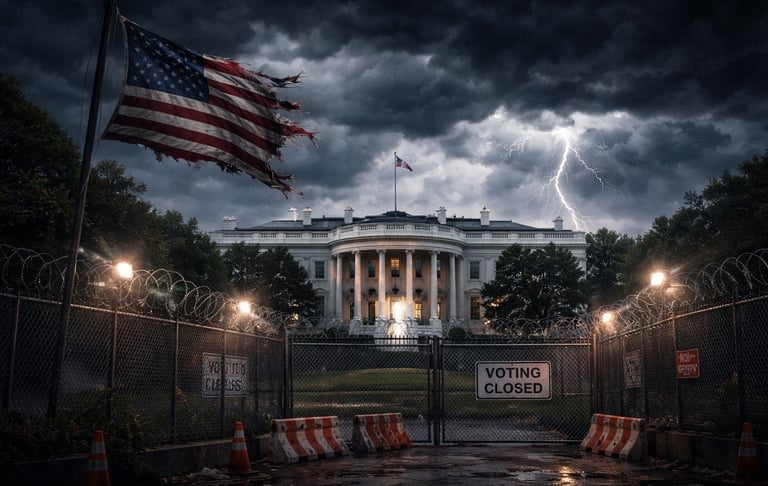
AI Generated Image
itsmyview.com © 2023-2025 All Rights Reserved
It's My View empowers people with the knowledge and tools to participate in meaningful political discourse and contribute to positive change.
Reframe your inbox
Subscribe to my blog and never miss a story.
We care about your data in our privacy policy.