The War That Is Both Won and Not Won
For the record, the President of the United States is now advancing four claims that cannot logically coexist—sometimes within the same speech, sometimes within the same week: He has already won the war. He is currently winning the war. He needs help to win the war. He needs no help to win the war.
TRUMPMEDIAPOLITICSDEMOCRACY
For the record, the President of the United States is now advancing four claims that cannot logically coexist—sometimes within the same speech, sometimes within the same week:
He has already won the war.
He is currently winning the war.
He needs help to win the war.
He needs no help to win the war.
And all of this, we are told, is in service of destroying a nuclear program he also claimed was already destroyed last year.
At some point, this stops being messaging. It stops being spin. It becomes something more serious: a collapse of basic coherence at the highest level of leadership.
When Contradiction Becomes Strategy
In normal circumstances, contradictions like these would trigger immediate scrutiny. They would demand clarification, correction, accountability.
Instead, they are deployed almost as a strategy.
If the war is already won, the President can claim decisive strength.
If it is still being won, he can claim momentum and progress.
If help is needed, he can rally allies and demand support.
If no help is needed, he can project dominance and independence.
Every audience hears what it wants. Every outcome is pre-labeled a success.
This isn’t clarity—it’s narrative insulation. It’s a system designed so that nothing that happens can ever be framed as failure.
The Elastic Definition of “Victory”
In this framework, victory is no longer a measurable outcome. It’s a moving target—constantly redefined to fit the moment.
If the situation improves, it’s proof the strategy worked.
If it deteriorates, it’s proof more time or support is needed.
If nothing changes, it’s reframed as “steady progress.”
There is no longer a fixed point where the public can say: this is what success looks like, and this is what failure looks like.
And without that distinction, accountability disappears.
The Nuclear Program Paradox
At the center of all of this is the stated objective: eliminating a nuclear program that, according to prior declarations, had already been eliminated.
This is not a minor inconsistency. It cuts directly to the credibility of the entire justification for conflict.
If the program was truly destroyed last year, escalation now makes no sense.
If escalation is necessary now, then the earlier claim was false or misleading.
There are only a few possibilities:
The threat was exaggerated before.
The threat is being exaggerated now.
Or the narrative is being adjusted in real time to fit political needs.
None of these scenarios inspire confidence. All of them raise serious questions.
The International Cost of Confusion
Contradictions like these don’t exist in a vacuum. The rest of the world is watching—and reacting.
Allies depend on consistency. They need to know what the United States believes, what it intends, and where it stands. Mixed signals weaken coordination and trust.
Adversaries, on the other hand, thrive on ambiguity. Conflicting statements create openings—opportunities to test limits, exploit uncertainty, and challenge credibility.
When the message shifts constantly, it becomes harder to deter opponents and easier to miscalculate.
And in the context of war—especially one tied to nuclear concerns—miscalculation is not a theoretical risk. It’s a real one.
The Domestic Consequence: Erosion of Trust
At home, the impact is just as corrosive.
Citizens are asked to support policies, fund conflicts, and accept risks based on information that does not hold together under basic scrutiny.
When leadership says everything at once—success, struggle, strength, vulnerability—it becomes impossible for the public to separate reality from rhetoric.
Over time, that breeds cynicism. People stop believing not just the statements, but the institutions behind them.
And once that trust is gone, it’s incredibly difficult to rebuild.
This Is Not a Messaging Problem
It’s tempting to dismiss all of this as poor communication—a lack of discipline, a failure of messaging strategy.
But that explanation falls short.
This is not about saying the wrong thing. It’s about saying every thing—simultaneously—so that no single statement can be pinned down, tested, or disproven.
It’s not confusion by accident. It’s confusion as a shield.
Chaos Isn’t Strength
Strong leadership requires clarity. It requires consistency. It requires the willingness to define success—and accept responsibility if that success isn’t achieved.
What we’re seeing instead is something very different:
A system where contradictions are routine.
Where goals shift without acknowledgment.
Where victory is declared regardless of reality.
That’s not strength.
That’s not strategic flexibility.
That’s not leadership.
It’s chaos—carefully packaged as confidence—and it leaves everyone else, from allies to citizens, to navigate the consequences of a story that refuses to stay consistent long enough to be true.
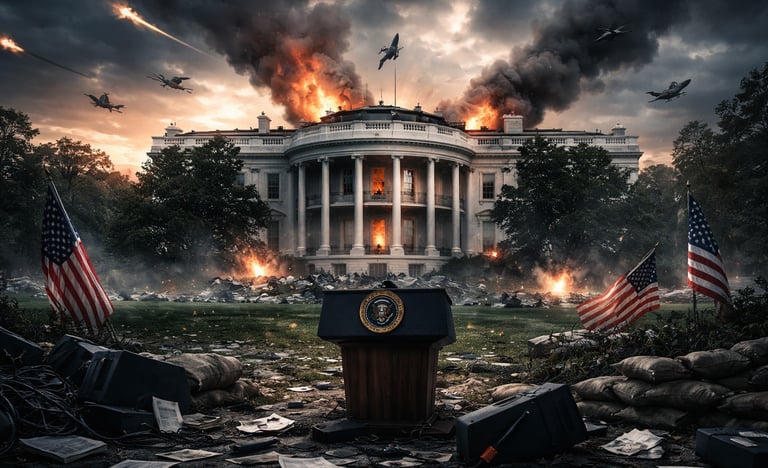
AI Generated Image
itsmyview.com © 2023-2025 All Rights Reserved
It's My View empowers people with the knowledge and tools to participate in meaningful political discourse and contribute to positive change.
Reframe your inbox
Subscribe to my blog and never miss a story.
We care about your data in our privacy policy.