Third From the Bottom: Trump’s “Winning” Economy Is Getting Beat by the World
For years, Donald Trump has repeated the same boast: that under his leadership the United States is experiencing the greatest economy in history. The claim is delivered with the usual theatrics—superlatives, chest-thumping, and the promise that America is “winning like never before.”
ECONOMICSTRUMPMEDIAPOLITICS
For years, Donald Trump has repeated the same boast: that under his leadership the United States is experiencing the greatest economy in history. The claim is delivered with the usual theatrics—superlatives, chest-thumping, and the promise that America is “winning like never before.”
But when you step away from the rally stage and look at the scoreboard the global financial markets provide, the story looks very different.
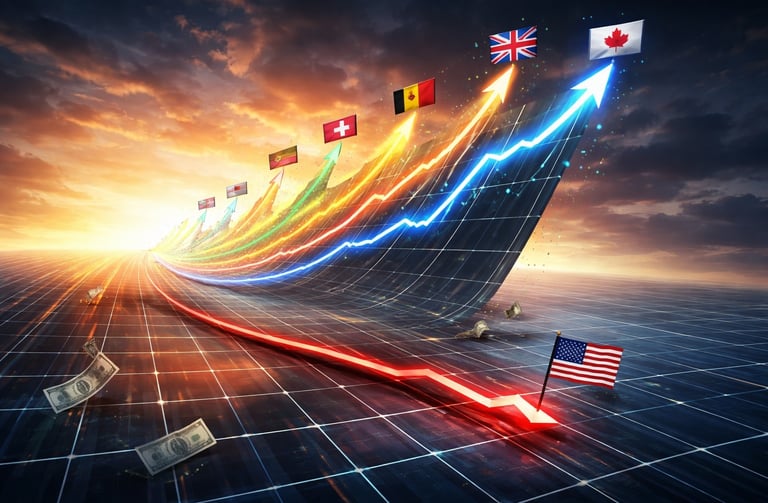
Out of 23 comparable wealthy economies, the United States currently ranks third-to-last in stock market returns during Trump 2.0.
That’s not partisan commentary.
That’s the market’s verdict.
The Global Scoreboard
Stock markets are one of the clearest real-time indicators of how investors—large and small—perceive an economy’s future. They measure confidence, capital flows, and expectations about growth.
And right now, that confidence is shifting away from the United States.
While American investors have been told that the economy is booming, global markets have been quietly outperforming the U.S. by large margins. In some countries, stock markets have delivered double or even triple the gains of U.S. benchmarks like the S&P 500.
For decades, U.S. markets dominated the world. From roughly 2010 through the early 2020s, American stocks consistently outpaced Europe, Japan, and many other developed economies.
That advantage is fading.
And the timing isn’t coincidental.
Markets Don’t Care About Slogans
Financial markets are famously unsentimental. They don’t vote. They don’t watch cable news. They don’t respond to campaign slogans.
They respond to policy signals and risk.
Investors evaluate questions like:
Will trade wars disrupt supply chains?
Will tariffs trigger retaliation from other countries?
Will political instability affect long-term investment?
Will fiscal policy produce sustainable growth or short-term chaos?
Under Trump’s second presidency, those risks have multiplied.
Trade conflicts, unpredictable economic messaging, and aggressive tariff threats have created a level of uncertainty that global investors dislike intensely.
Capital flows toward stability. When policy becomes volatile, money looks for calmer waters.
Right now, many investors appear to be finding those calmer waters outside the United States.
The Myth of Economic “Winning”
Trump’s political brand revolves around the concept of winning. Every policy, every speech, every social media post reinforces the narrative that America under his leadership is dominating the global economy.
But if the goal is dominance, the rankings tell a different story.
Being 21st out of 23 wealthy nations in stock returns isn’t dominance.
It isn’t leadership.
It’s barely avoiding last place.
Imagine a CEO boasting about corporate success while the company’s stock lags nearly every competitor in the industry. Shareholders wouldn’t applaud the speech—they’d question the leadership.
Yet in politics, the performance gap often disappears behind messaging.
The World Isn’t Waiting for America
Another uncomfortable reality emerges from these numbers: the rest of the world is not dependent on U.S. economic leadership the way it once was.
For years, global investors assumed American markets were the safest and most profitable place to park their money. That assumption helped fuel the extraordinary rise of U.S. equities.
But when other developed markets begin outperforming—sometimes dramatically—capital begins to diversify.
Money that once flowed automatically into the United States begins spreading elsewhere.
And once those habits change, they can be difficult to reverse.
The Real Question
The central political question is not whether Trump will continue claiming victory. That part is predictable.
The real question is whether Americans will look past the rhetoric and examine the results.
Because the results are sitting in plain view on the global financial scoreboard.
Out of 23 comparable wealthy countries, the United States is third from the bottom in stock market performance during Trump 2.0.
For a presidency built on promises of relentless winning, that statistic is hard to ignore.
So the obvious question remains:
If this is what “winning” looks like… when does the winning actually start?
AI Generated Image
itsmyview.com © 2023-2025 All Rights Reserved
It's My View empowers people with the knowledge and tools to participate in meaningful political discourse and contribute to positive change.
Reframe your inbox
Subscribe to my blog and never miss a story.
We care about your data in our privacy policy.