Trump Rhetoric: This Is What Really Hurts
The most painful part of Trump’s Rob Reiner post isn’t what Trump wrote. That part barely registers anymore. It’s familiar. Expected. A rerun of the same small, mean performance he’s been delivering for nearly a decade.
TRUMPMEDIAPOLITICSCULTURE
The most painful part of Trump’s Rob Reiner post isn’t what Trump wrote. That part barely registers anymore. It’s familiar. Expected. A rerun of the same small, mean performance he’s been delivering for nearly a decade.
Cruelty is not a glitch in Trump’s personality—it is the product. So no, the words themselves aren’t the shock.
What hurts is everything they remind us of.
The Cruelty Has an Audience
What hurts is the reminder that roughly 30% of this country supports a man who speaks this way—openly, proudly, without shame. Not reluctantly. Not while holding their nose. But enthusiastically.
They see posts like that and don’t recoil. They don’t feel embarrassment. They don’t worry about what it says about the country or themselves. They applaud it. They call it “telling it like it is.” They confuse cruelty for courage and malice for strength.
That’s the part that sinks in every time.
This isn’t just one man being vile. It’s a movement that rewards vileness.
Power Without Consequence
What hurts is knowing that the Supreme Court keeps expanding his power instead of restraining it. A court that was designed to be a guardrail against authoritarianism has instead become its legal defense team.
Each ruling sends the same message:
There are rules for everyone else—and then there are exemptions for Trump.
Presidents aren’t kings.
Unless they’re this one.
The Court doesn’t just excuse his behavior; it normalizes it, laundering authoritarian impulses through legal language until they come out sounding respectable. History will not remember this as neutrality. It will remember it as complicity.
A Congress That Won’t Do Its Job
What hurts is watching Congress stand by—again and again—while pretending its hands are tied.
They aren’t tied. They’re folded.
Folded out of fear. Folded out of ambition. Folded because speaking up might cost a primary, a donation, or a future cable news slot. So instead of governing, they appease. Instead of confronting abuse of power, they calculate how to survive it.
This isn’t gridlock.
It’s abdication.
And the cost isn’t theoretical. It’s moral. It’s institutional. It’s generational.
Living in the Upside Down
Every post like Trump’s is a reminder that we’re living in a country where the rules have inverted.
Cruelty is branded as honesty.
Accountability is framed as persecution.
Calling out abuse is “divisive,” while committing it is “leadership.”
We are told to calm down, move on, stop being so sensitive—while the degradation of our democracy happens in real time, in plain sight, cheered on by millions and protected by the most powerful institutions in the country.
That’s what really hurts.
It Was Never Just About Trump
Trump is not the disease. He’s the symptom.
The disease is a political culture that rewards cruelty, excuses authoritarianism, and punishes empathy. A system that bends itself into knots to protect power instead of people. A nation that keeps being forced to confront the uncomfortable truth that a large portion of its citizens are perfectly fine with all of this.
That’s the gut punch.
Not the post—but the reminder that the post works.
That we’re stuck in a version of America where decency feels naïve, accountability feels optional, and the loudest voice in the room keeps getting handed the microphone.
And the hardest part to accept is this:
The upside down isn’t an accident anymore.
It’s a choice.
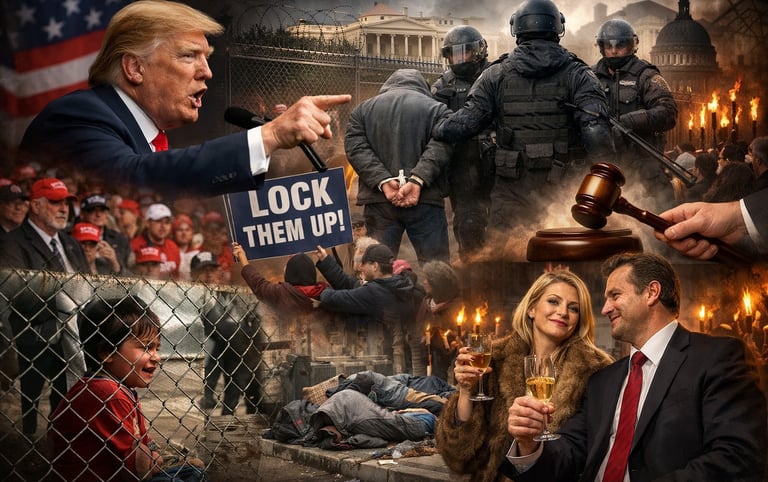
AI Generated Image
itsmyview.com © 2023-2025 All Rights Reserved
It's My View empowers people with the knowledge and tools to participate in meaningful political discourse and contribute to positive change.
Reframe your inbox
Subscribe to my blog and never miss a story.
We care about your data in our privacy policy.