Voting Is a Right — Not a Privilege to Be Restrained
When the President of the United States refers to voting as “the greatest privilege of them all,” that isn’t just loose language — it echoes a dangerous narrative many democracy scholars, civil rights advocates, and historians warn against.
ELECTIONSDEMOCRACYTRUMPRIGHTS
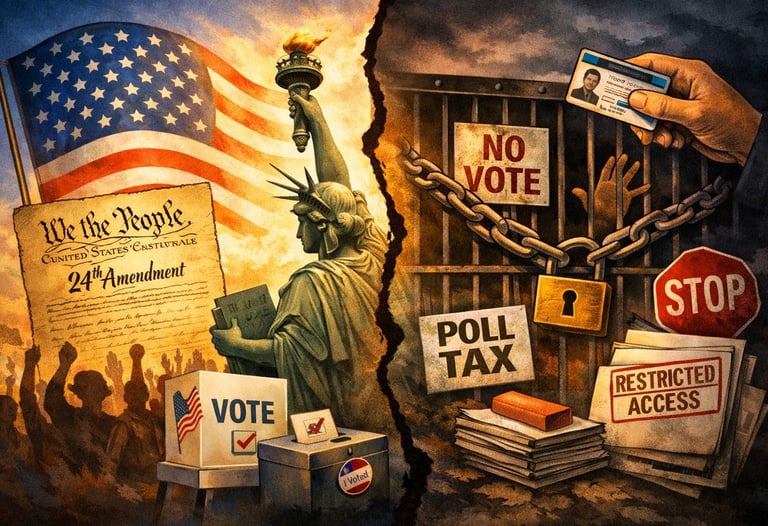
When the President of the United States refers to voting as “the greatest privilege of them all,” that isn’t just loose language — it echoes a dangerous narrative many democracy scholars, civil rights advocates, and historians warn against. In his 2026 State of the Union address, the president asked Congress to pass the SAFE America Act (SAVE Act) and characterized voting access in terms that, if normalized, could justify stripping millions of eligible Americans of equal participation rights.
Let’s break down why this matters — legally, historically, and politically.
The Constitution Protects the Right to Vote
Voting in the United States isn’t a discretionary gift handed down by political leaders — it’s the result of centuries of struggle and explicit constitutional guarantees. Amendments to the Constitution reaffirm that voting is a fundamental right, not a conditional privilege:
The Fifteenth Amendment to the United States Constitution forbids race-based voting denial.
The Nineteenth Amendment to the United States Constitution prohibits sex-based voting barriers.
The Twenty-Fourth Amendment to the United States Constitution bans poll taxes.
The Twenty-Sixth Amendment to the United States Constitution guarantees the vote to citizens 18 and older.
Courts have repeatedly described voting as a fundamental right, central to democratic self-governance — not a discretionary privilege that can be tightened or loosened at will.
What the President Actually Said in the State of the Union
In the February 24, 2026 address, Trump urged lawmakers to adopt the SAVE Act — a proposal to require proof of citizenship and stricter voter ID in federal elections, and to curtail most mail-in voting except for limited categories like military or illness.
His exact words included a line such as:
“Yet they don’t want identification for the greatest privilege of them all, voting in America.”
That phrase — calling voting a privilege dependent on specific documents — isn’t found in the Constitution or in landmark Supreme Court rulings; it’s a political framing, and an influential one at that.
Fact Check: Key Claims About Voting and Fraud
Here’s what independent fact-checking organizations found regarding the substance of the speech:
📉 “Cheating is rampant in our elections” — Not supported by evidence
Multiple outlets that examined the president’s claims concluded there is no evidence of widespread election fraud in U.S. elections. False votes, including non-citizen votes, have been shown to occur at extremely low rates, and no election in recent history has been overturned due to systemic fraud.
📊 SAVE Act implications are more complex than described
While the president described the SAVE Act as straightforward election integrity legislation, fact checkers note it would impose new documentation requirements that far exceed current federal law and could make registering and voting much harder for millions. For example:
Proof of citizenship beyond a simple attestation on a voter registration form is not currently required in federal elections.
Many eligible citizens do not possess passports or citizenship papers, even though they have the right to vote.
📬 Mail-in voting isn’t widespread fraud
The president claimed most mail-in ballots are “crooked,” suggesting fraud. But most states with robust election systems use mail-in voting safely and securely, and experts say fraud in mail ballots is extremely rare.
Why Framing Matters: Democracy or Restriction?
Calling voting a “privilege” rather than reinforcing its constitutional basis as a right — especially in a national speech watched by millions — shifts the narrative toward control rather than access. It creates a context in which:
Citizens without certain IDs feel less empowered to participate.
Policies that make voting harder are justified as normal safeguards.
Historic civil rights guarantees are reframed as optional protections.
This matters because access to the ballot box has historically been a battleground — not only in the Jim Crow South but in more recent efforts to reduce hurdles to registration and participation. The Constitution’s amendments on voting were written to protect and expand participation — not to condition it on arbitrary requirements.
Bottom Line
The president’s phrasing in the 2026 State of the Union — calling voting a “privilege” tied to identification — was accurate as a quote, but it reflects political framing, not constitutional law. Fact-check reporting confirms parts of the speech about voter fraud and mail ballots are unsubstantiated or misleading, and the legislative changes proposed would change the nature of voting access for many Americans.
Voting is not a privilege handed down by politicians — it’s a right protected by the Constitution and reaffirmed by decades of civil rights progress. Guarding against restrictions that risk disenfranchisement is essential to preserving a government that truly reflects the will of the people.
AI Generated Image
itsmyview.com © 2023-2025 All Rights Reserved
It's My View empowers people with the knowledge and tools to participate in meaningful political discourse and contribute to positive change.
Reframe your inbox
Subscribe to my blog and never miss a story.
We care about your data in our privacy policy.