When Losing the Voters Means Undermining the Vote
Authoritarians don’t usually announce that they’re afraid of elections. They just start sabotaging them. If a political movement becomes convinced that it can no longer reliably win the popular vote, it faces a choice: broaden its appeal—or narrow the electorate.
ELECTIONSRIGHTSREPUBLICANSTRUMPDEMOCRACY
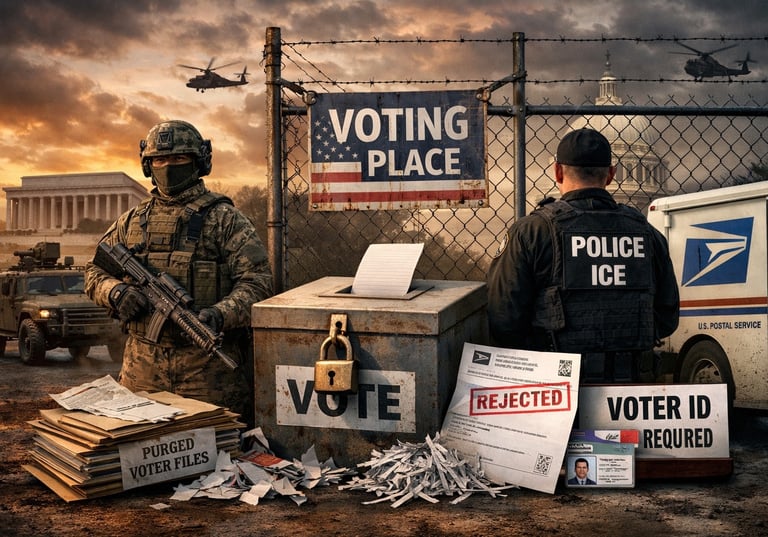
Authoritarians don’t usually announce that they’re afraid of elections.
They just start sabotaging them.
If a political movement becomes convinced that it can no longer reliably win the popular vote, it faces a choice: broaden its appeal—or narrow the electorate. History shows which option fragile strongmen prefer.
The fear many Americans are voicing right now isn’t abstract. It’s rooted in a pattern: when leaders claim the system is “rigged” only when they lose, and “perfect” when they win, they aren’t defending democracy. They’re preparing their supporters to distrust it.
And once distrust becomes doctrine, restricting participation becomes easier to justify.
The SAVE Act and Voter Eligibility Battles
One of the most controversial proposals circulating in conservative circles is legislation requiring documentary proof of citizenship to register to vote in federal elections. Supporters argue it protects election integrity. Critics argue it risks disenfranchising eligible voters—particularly married women whose legal names no longer match their birth certificates, as well as low-income and elderly citizens who may lack easy access to required documentation.
The debate isn’t about whether only citizens should vote—that’s already the law. The fight is over whether new procedural hurdles would meaningfully address fraud (which numerous audits and court cases have found to be rare) or instead reduce turnout among lawful voters.
When a party consistently struggles with certain demographics, tightening access can start to look less like policy and more like strategy.
Mail-In Voting and Administrative Barriers
Mail-in voting became a partisan battlefield in 2020. Since then, disputes over postmark deadlines, ballot curing processes, and delivery windows have intensified. Small administrative tweaks—how a postmark is interpreted, how late a ballot can arrive, whether signature mismatches can be corrected—can affect thousands of votes.
Election law experts across the political spectrum agree on one thing: procedure matters. When rules change close to elections or are inconsistently applied, public trust erodes.
Whether changes are framed as “security measures” or “anti-fraud safeguards,” the key question remains: do they expand access while maintaining integrity—or create friction that predictably suppresses participation?
The Chilling Effect of Law Enforcement Presence
There is a long and ugly history in the United States of using intimidation—overt or subtle—to discourage turnout. Federal law already prohibits voter intimidation. Still, the mere perception that immigration enforcement or other armed authorities are hovering near polling places can depress participation in vulnerable communities, even if no formal misconduct occurs.
Intent matters. So does effect.
Democracy depends not just on the right to vote, but on the confidence to exercise that right freely.
Voter Roll Purges and Data Controversies
Maintaining accurate voter rolls is legally required. States routinely remove deceased voters and those who have moved. But controversies arise when aggressive purges rely on flawed data matching or error-prone databases.
Past investigations have shown that sloppy cross-state matching systems can flag eligible voters incorrectly. When removal notices are unclear or difficult to contest, lawful voters can show up on Election Day only to discover they’ve been purged.
If election security is the goal, transparency and due process are essential. Otherwise, the effort looks selective.
The Martial Law Rhetoric
Speculation about canceling elections through emergency powers is, at this point, political rhetoric rather than an established policy. Courts, states, and constitutional law impose significant barriers to suspending federal elections. But the fact that such ideas circulate in online ecosystems reflects something deeper: normalization of extraordinary measures.
When a movement repeatedly describes routine elections as existential threats, it lowers the psychological barrier to extreme responses.
Democracies don’t usually collapse overnight. They erode when people become accustomed to the idea that voting is optional, conditional, or secondary to loyalty.
The Real Question
This isn’t about one man. It’s about a principle.
If a political movement believes it cannot win fairly, does it adapt its message—or attempt to reshape the electorate?
The health of American democracy doesn’t depend on which party wins. It depends on whether both parties accept the rules when they lose.
If any leader—Republican or Democrat—tries to restrict lawful participation because they fear the outcome, that is the moment citizens should be alarmed.
Because once elections are treated as obstacles instead of obligations, democracy is already in retreat.
And history is clear about what comes next.
AI Generated Image
itsmyview.com © 2023-2025 All Rights Reserved
It's My View empowers people with the knowledge and tools to participate in meaningful political discourse and contribute to positive change.
Reframe your inbox
Subscribe to my blog and never miss a story.
We care about your data in our privacy policy.