When “Mail-In Voting” Is Fine—As Long As He Does It
Donald Trump has gone back to a familiar talking point, branding mail-in voting as “mail-in cheating.” It’s a phrase he’s repeated for years—loudly, consistently, and without evidence strong enough to withstand scrutiny in courtrooms across the country.
ELECTIONSTRUMPPOLITICSDEMOCRACY
Donald Trump has gone back to a familiar talking point, branding mail-in voting as “mail-in cheating.” It’s a phrase he’s repeated for years—loudly, consistently, and without evidence strong enough to withstand scrutiny in courtrooms across the country.
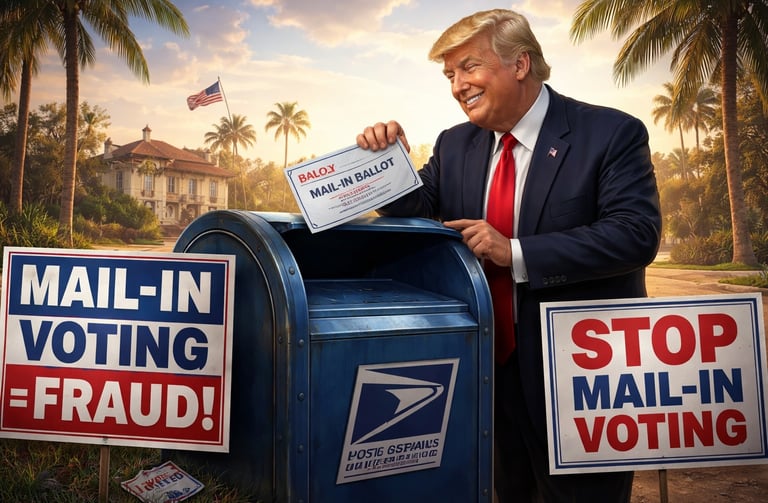
But here’s the part that matters: that same day, it was reported that he himself voted by mail in a Florida special election.
Not absentee out of necessity. Not from across the country. From Florida. With a polling place roughly 15 minutes away from Mar-a-Lago. A place he had reportedly spent the previous two weekends.
He could have voted in person. Easily. Conveniently. Without disruption.
He chose not to.
The Double Standard Isn’t Subtle
This isn’t complicated. When everyday Americans vote by mail, it’s framed as suspicious. Dangerous. A threat to democracy. When Trump does it, it’s just… voting.
No alarm bells. No warnings. No claims of fraud.
That contradiction isn’t just hypocrisy—it’s strategy.
Because the goal was never about the method of voting. It was about control over who votes, how they vote, and how easy it is for them to participate in the process.
Restrict It for You, Preserve It for Him
Now comes the second layer: pushing for legislation that would make voting—especially methods like mail-in voting—harder for millions of Americans.
While using that very method himself.
That’s not a policy position. That’s not a principled stance. That’s using the system while actively working to limit others’ access to it.
It’s the political equivalent of pulling up a ladder after you’ve already climbed to the top.
Manufacturing Distrust
Labeling something as “fraudulent” while personally relying on it serves a purpose: it erodes trust.
If enough people believe the system is rigged, they disengage. They stop voting. They lose confidence in outcomes. And that vacuum benefits those who thrive on lower participation and higher confusion.
It’s not about securing elections—it’s about shaping who shows up to them.
The Real Issue
Mail-in voting isn’t new. It’s been used for decades by military members, seniors, rural voters, and yes—politicians from both parties. Courts, audits, and election officials across the country have repeatedly found no widespread fraud that would justify dismantling it.
What is new is the attempt to delegitimize it while quietly continuing to use it.
Call It What It Is
When a leader says one thing and does another—especially on something as fundamental as voting—that’s not just hypocrisy.
It’s a warning sign.
Because democracy doesn’t just depend on laws. It depends on trust. And when those in power actively undermine that trust while benefiting from the very system they attack, the damage goes far beyond a single election.
It cuts at the foundation of the entire process.
You don’t get to call it cheating—then mail in your own ballot.
AI Generated image
itsmyview.com © 2023-2025 All Rights Reserved
It's My View empowers people with the knowledge and tools to participate in meaningful political discourse and contribute to positive change.
Reframe your inbox
Subscribe to my blog and never miss a story.
We care about your data in our privacy policy.