When Supreme Court Justices Can Use Dubious Data to Dismantle Voting Rights
If an ordinary lawyer submitted false or misleading data in a legal filing, they could face sanctions, lose their reputation, or even be disbarred. But when a Supreme Court justice uses deeply disputed claims or questionable factual framing in a ruling that reshapes American democracy, there is often no accountability at all.
COURTSPOLITICSELECTIONS
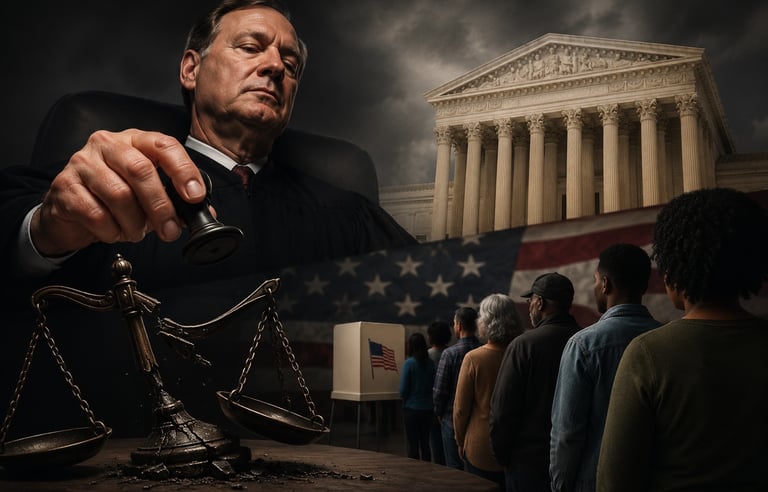
If an ordinary lawyer submitted false or misleading data in a legal filing, they could face sanctions, lose their reputation, or even be disbarred.
But when a Supreme Court justice uses deeply disputed claims or questionable factual framing in a ruling that reshapes American democracy, there is often no accountability at all.
That is the outrage surrounding Samuel Alito and the Supreme Court’s continued weakening of the Voting Rights Act of 1965 through rulings tied to Louisiana’s congressional maps and voting rights disputes.
The issue is not simply ideological disagreement. Courts are supposed to operate on facts, evidence, and constitutional reasoning. But critics argue that recent voting-rights decisions increasingly rely on selective interpretations of data and history while ignoring the real-world impact on minority voters.
And unlike every other level of the legal system, Supreme Court justices face almost no meaningful consequences when their reasoning proves misleading, politically distorted, or detached from reality.
The Supreme Court’s Extraordinary Power
The Supreme Court is not just another court.
Its decisions can rewrite how elections work, redefine constitutional protections, and permanently alter the balance of political power in the United States.
The people making those decisions are unelected.
They serve for life.
And there is effectively no higher authority to review them.
That level of power demands extraordinary rigor and honesty.
Instead, Americans increasingly see rulings that appear driven more by ideological outcomes than neutral legal analysis.
In Louisiana voting-rights cases, the Court has repeatedly been forced to confront evidence that racial discrimination in districting and voting access remains a modern reality, not a relic of the past. Yet conservative justices continue pushing doctrines that make it harder to challenge discriminatory maps and voting restrictions.
Critics argue that some of the factual assumptions behind those rulings simply do not hold up under scrutiny.
A Different Standard for the Powerful
Imagine a trial attorney knowingly presenting inaccurate statistics or misleading factual claims to a judge. That attorney could face disciplinary action immediately.
Now compare that to a Supreme Court justice issuing a constitutional ruling based on disputed or distorted interpretations of data that affects millions of voters nationwide.
The ruling stands.
The justice keeps their seat.
There is no ethics tribunal.
No removal.
No accountability.
That double standard erodes public trust in the judiciary itself.
The legal system tells ordinary citizens that facts matter and dishonesty carries consequences. But the highest court in the country increasingly appears insulated from the very standards it expects everyone else to follow.
Gutting the Voting Rights Act Piece by Piece
The weakening of the Voting Rights Act did not happen all at once.
It has occurred through a series of decisions that narrowed enforcement powers, weakened protections, and made it harder for minority communities to challenge discriminatory voting practices.
The Court insists these rulings are about constitutional limits and legal consistency.
But the practical outcome is unmistakable:
fewer federal protections,
more barriers to voting challenges,
and greater freedom for states to redraw maps or pass laws that disproportionately impact Black and Brown voters.
Louisiana became one of the clearest battlegrounds in that fight because demographic realities collided directly with political power. Courts repeatedly found evidence supporting additional minority representation, while conservative legal arguments sought to limit or reinterpret those protections.
The result is a judiciary increasingly viewed not as an impartial referee, but as an active participant in reshaping democratic rules.
Lifetime Appointments Were Never Meant to Mean Lifetime Immunity
The framers designed lifetime judicial appointments to protect judges from political pressure — not to shield them from ethical scrutiny or factual accountability.
Those are two very different things.
A justice should not lose independence because of unpopular rulings. But neither should they operate beyond meaningful standards when making decisions that affect the constitutional rights of millions.
When Americans see powerful judges using questionable reasoning while facing zero consequences, faith in the institution collapses.
And once public trust in the courts erodes, democracy itself becomes more unstable.
The Real Danger
The greatest danger is not one ruling or one justice.
It is the normalization of a judiciary that appears increasingly comfortable acting as a political institution while still demanding the unquestioned legitimacy of a neutral one.
Because when the Supreme Court weakens voting protections using reasoning many legal scholars and civil-rights advocates view as deeply flawed, Americans begin asking a dangerous question:
If facts and honesty are mandatory for everyone else in the legal system, why do the most powerful judges in the country appear exempt?
AI Generated Image
itsmyview.com © 2023-2025 All Rights Reserved
It's My View empowers people with the knowledge and tools to participate in meaningful political discourse and contribute to positive change.
Reframe your inbox
Subscribe to my blog and never miss a story.
We care about your data in our privacy policy.